

.svg)
How Many Backlinks Before You Can Rank in Search Engines?
As human beings, we can’t help but try to compartmentalize and quantify things.
Or at least, that’s the case for us SEO nerds.
Google is notoriously vague, and sometimes tight-lipped, about the exact mechanics of its search ranking algorithm (and for good reason, as we’ll see). That’s frustrating when you’re trying to make practical decisions, like how much time and budget to put toward link building.
You probably already know backlinks matter. They can help your pages gain authority, show up higher in search results, and attract more organic traffic from search engines.
But sometimes, we just get an itch to try and figure out more specifics.
Presumably, you all know that backlinks are important for SEO progress.
So exactly how many backlinks do you need before you start to rank?
The honest answer is that there isn’t one fixed number. The backlinks needed depend on your industry, your competitors, your keyword difficulty, your existing authority, your content quality, and the strength of the referring domains linking to you.
Still, that doesn’t mean you have to guess. There’s a practical way to estimate how many backlinks you’ll need, and it starts with understanding what backlinks actually do.
A Primer on Backlinks and SEO
If you're already familiar with backlinks and their relationship to SEO, feel free to skip this section.
As a primer, backlinks are hyperlinks from other websites that are pointed to a web page on your website. Earning backlinks is valuable for many reasons, as they increase visibility of your website and send traffic your way, and help search engines understand that your content may be worth trusting.
More relevantly to SEO, backlinks serve as a kind of vote of confidence. When relevant websites link to your content, those links can help strengthen your domain authority and page authority. While the mechanics of calculating authority are somewhat complicated and poorly understood, we do understand that the quantity and quality of your backlinks has a direct bearing on your domain authority and page authority.
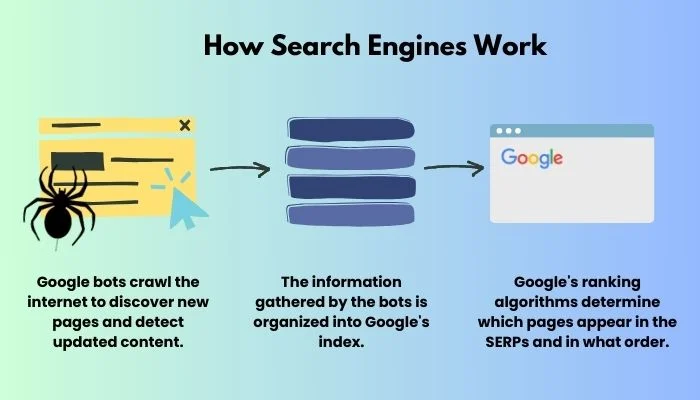
The higher your domain authority rises, the more likely your web pages are to rank highly in Google searches.
The higher your page authority rises, the more likely that individual web page is to rank highly in Google searches.
In other words, earn lots of quality backlinks and you'll rise to the top of the search engine results pages (SERPs) for queries relevant to your website.
There are a couple of caveats, however.
First, backlinks aren't quite as powerful or as important as they used to be, as Google now has hundreds of ranking factors as part of its algorithm. Still, backlinks are one of the most important pieces of any SEO strategy. Backlinks are still a major ranking factor, but they are not the only ranking factor. Your technical SEO, content quality, search intent match, internal linking, and on page optimization all matter too.
Second, spamming backlinks or building them blindly is a bad idea. Google cracks down on spamming practices and highly values genuinely authoritative websites. Accordingly, your backlinks need to be as natural as possible, providing value to users, which helps maintain a natural backlink profile. One way to help this is through internal linking, where you link to other web pages within your site, improving the relevance and connectivity of your content.
That’s why modern link building is less about chasing a big number and more about earning high quality backlinks from sites that make sense. A few editorial links from respected industry publications can be worth far more than dozens of weak directory links.
This is also where your link structure comes into play. Links from external sources matter, but the way you connect pages across your own site can help search engines understand which pages are most important.
There's no question that building quality backlinks from strong referring domains is a good thing, and more high-quality links will support your SEO efforts.
But how many backlinks are we talking about? Having too few backlinks means your web pages won't have enough authority to rank effectively, so you need to rank with a solid number of incoming links that are natural and valuable.
The Google Opacity Problem
Unfortunately, we can't give you a straightforward answer, in part because Google isn't forthcoming or transparent about its ranking algorithm. We know that backlinks are important, both because Google implies it and because we can measure the impact of earning more backlinks. However, we don't know exactly how this formula works or how individual backlinks are evaluated.
What we can do is quantify the pieces of data we do understand and use our wealth of experience to estimate the value of individual backlinks so we can form a more coherent picture. We can review the search results, study competing pages, evaluate their referring domains, look at the quality backlinks they’ve earned, and estimate the backlinks needed to compete.
That estimate will never be perfect. But it’s a whole lot better than guessing.
Defining Our Terms: How Many Backlinks Before You Can Rank in Search Engines?
It's also hard to give a straightforward answer because the terminology of the question is too vague. SEO is a very complicated strategy that takes hundreds of variables into consideration, so we need to narrow things down if we're going to answer the question.
First, what exactly do we mean by “backlinks”?
Obviously, we've already defined what backlinks are and why they're important for SEO. However, not all backlinks are equal. There are many different types of backlinks – and they vary in terms of impact.
For example:
- Domain authority and page authority. The power of a backlink depends heavily on the domain authority (DA) of the referring domain and the page authority (PA) of the referring page. As you might imagine, the higher the authority, the more valuable the link is. Earning a backlink from a website with a DA of 85 is going to count much more than earning a backlink from a website with a DA of 20. In fact, a single backlink from an 85 DA website might be much more valuable than several backlinks from 20 DA websites. Put simply, some quality backlinks are much more valuable than others.
- Topical relevance. Topical relevance does enter the equation as well. Generally speaking, it's better to have relevant links from websites that are topically aligned with your website. This isn't strictly necessary, and it's perfectly acceptable to have relevant links from other sources, but relevant backlinks are going to be more valuable to search engines.
- Visibility and traffic. The visible prominence of the referring website, as well as the traffic generated by it, will not have a direct bearing on your search rankings. However, there can be indirect benefits; increasing traffic and engagement with your website can support it in your SEO efforts. You'll also benefit from having more people exposed to your brand.
- Naturality. Links need to be natural if they're going to support your SEO efforts. If your links stand out too much, if they aren't valuable for users, if they aren't relevant to the content in which they're placed, or if they otherwise seem spammy, they could actively work against you. Strong link building should feel like real citation, not forced promotion.
- Number of referring domains. You’ll also need to factor in the number and diversity of referring domains pointed to your website. Building three links on the same website isn't nearly as valuable as building three links on three different websites, even if that original website has a high authority. This won't matter much if you only have one referring domain, but as your efforts scale, it becomes increasingly important to get links from new, powerful referring domains.
- Pace and scale of backlinks. Finally, you'll need to think about the pace and scale of your backlink building efforts. Yes, it's probably a good thing to earn more backlinks, but if you try to build them all in the span of an afternoon, you're going to end up with a penalty. Natural backlink growth usually happens gradually and includes a healthy mix of editorial links, brand mentions, guest contributions, resource links, press releases, and other legitimate placements.
Second, what do we mean by “rank”?
Depending on your industry, your budget, and your long-term business goals, you could have any number of different objectives or targets for your SEO efforts. Some businesses are interested in reaching the number one position for a small handful of strategically valuable keywords. Other businesses want to reach page one for a large number of topically relevant keywords.
For our purposes, we’ll aim to find the number of backlinks necessary to support a decent ranking on page one for a reasonably valuable keyword. The higher you rank, the harder it becomes to increase your rankings, as you'll face steeper and steeper competition; accordingly, reaching rank one may not be a realistic goal in the early stages of your SEO strategy.
Even with this definition, there are ambiguities to contend with, but it's going to have to do, since every business and SEO strategy is unique.
The answer depends on keyword difficulty. A low-difficulty keyword may require only a handful of high quality links. A high-difficulty keyword may require hundreds of quality backlinks, a strong domain, excellent content quality, and a serious link building strategy.
The higher you want to rank, the harder it becomes. Moving from position 30 to position 12 may be easier than moving from position 5 to position 1. Once you’re competing near the top of the search results, every detail matters.
Other Variables to Consider
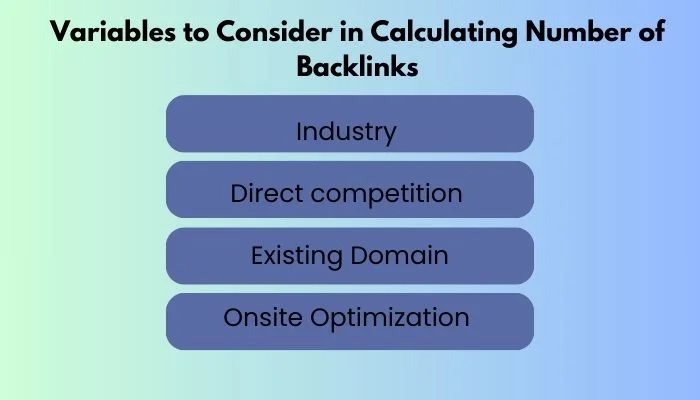
As you attempt to calculate how many backlinks you'll need to reach your SEO goals, you'll need to keep the following variables in mind:
- Your industry. Some industries are more established and more competitive than others. If you're trying to sell cars online, you'll have a lot more competition and keyword difficulty than if you're trying to sell a novel type of app that's never been seen before. Additionally, some industries benefit from SEO more than others; naturally, this attracts more competition and generally requires you to build more links to see results. There are some SEO strategies that can help you cope with this, such as focusing on local optimization, getting more referring domains, more quality backlinks, or tackling a specific niche within your industry. Still, this needs to enter your equations as a variable worth noting.
- Your direct competition. You'll also need to consider your more direct competition. Hopefully, by this stage of your SEO planning, you should have a selection of target keywords for which you want to rank. While your general industry will have an impact on the severity of your competition, individual competitors vary significantly in terms of strength – and they may or may not be competing against you for the same target keywords. Fortunately, this variable is much more in your control; if you find that there are too many competitors with hundreds of referring domains for your original selection of target keywords, you can always choose a different selection of keywords to make it easier to rank. If the current search results are weak, outdated, or thin, you may not need nearly as many backlinks to compete. With a couple of adjustments, and possibly some strategic compromises, you can reduce the number of backlinks that you need to build in order to rank.
- Your existing domain. Your existing domain authority also matters. If you just launched your website yesterday and you don't have much content on it, you're going to face an uphill battle, even if you earn a lot of backlinks. Conversely, if you already have an established web presence, adding even a few high quality backlinks could be a massive boost.
- Your onsite optimization. Remember that backlinks represent offsite optimization, and therefore only a portion of your SEO strategy. You'll also need an onsite SEO strategy, including content development, strategic keyword optimization, technical optimization, on page optimization, and more. If you have a website that's brimming with high-quality content that's laser focused on strategically valuable keywords, and your website technically performs well, half your work will be done already – and you won't need many backlinks to build SEO momentum. On the other end of the spectrum, if you only have a few thin pages and you haven't spent much effort on onsite optimization, even a host of diverse, high-authority backlinks may not be enough to compensate for your onsite problems.
- Your content quality. This one deserves extra attention. Content quality can change how many links you need. A better page can sometimes outrank a stronger page if it answers the query more clearly, loads faster, feels more trustworthy, and gives readers exactly what they came for. A great blog post that explains the topic better than competing pages has a better chance of earning natural editorial links over time.
- Your link types. Different links do different jobs. Editorial links from respected publications are usually the strongest. A thoughtful guest post on a relevant industry site can also help. Press releases can support visibility when you have real news to share, but they should not be your entire link building plan. Directory links can make sense for local SEO, industry associations, and niche listings, but low-quality directories rarely move the needle.
- Your referring domain mix. Pay attention to where your links come from. Ten backlinks from one site are not the same as ten backlinks from ten strong referring domains. Search engines often reward a diverse link profile because it shows that multiple sources trust your content.
Estimating How Many Backlinks You Need
Now that we've covered some of the finer details of backlink building and SEO, it's time for you to estimate the number of backlinks you'll need to reach your ranking goals. You'll have a much easier time now that you have full context for your calculations.
The easiest way to approach this is to study a close competitor.
For example, let's say you're interested in reaching position eight or higher for a specific keyword term, like “used [products] for sale.” Use a private browser to remove personalization and conduct a search for this term, modifying it to fit your industry. Then, take note of the page that's currently at rank eight. This page should be an adequate example of the effort necessary to reach this position.
Once you have that, you can plug it into any SEO competitive analysis tool or backlink profile checker. Your results will likely tell you how many backlinks are pointed to that page, where those backlinks are coming from, and what the DA scores of those referring domains are.
If this page has 50 backlinks, you'll probably need around 50 backlinks to contest it in search engine rankings.
You can repeat this process as many times as you'd like, studying different keywords and different strategic approaches. After a few rounds, you should have a much clearer picture of the number of backlinks you need to reach your strategic goals in your industry and competitive landscape.
A Real Answer
If you decided to read this article because you wanted a concrete, objective answer, you might be disappointed that we essentially gave you the answer: “it depends.” Despite our instructions on how to calculate a more specific answer for your unique situation, it might still be helpful to ballpark something more objective.
Even a small handful of links should be enough to help you build some initial momentum, increasing your domain authority. However, even in a relatively open industry, it's going to be hard for you to establish visible keyword rankings with a relatively new website.
Instead, you'll probably need a few dozen backlinks, or several backlinks from very high-authority sources, before you can break into the first page for some of your target keywords.
For a very low-competition keyword, you may need only a few high quality links, or even no backlinks at all if your site already has authority and the content is strong.
For a moderate keyword difficulty keyword, you may need a few dozen quality backlinks from a healthy mix of referring domains.
For a highly competitive keyword, you may need hundreds of backlinks, many strong referring domains, excellent content, smart internal linking, and a steady link building campaign.
That may sound like a lot, but remember: you don’t always need to rank for the hardest keyword first.
In many cases, the better strategy is to start with lower keyword difficulty terms, earn early rankings, bring in organic traffic, and build authority over time. As your site gains trust, you can target more competitive keywords.
A new website trying to rank for a broad national term will usually need a lot of help. A more established site targeting a specific long-tail phrase may need far less.
So here’s the real answer:
You need enough quality backlinks from enough trusted referring domains to compete with the pages already ranking in the search results.
Sometimes that means five.
Sometimes that means 50.
Sometimes that means 500.
The number only makes sense when you compare it to the actual pages you need to rank against.
And remember, more backlinks are not always better if they’re low quality. High quality backlinks from relevant websites will almost always beat a bigger pile of weak links. Strong link building is about earning trust, not inflating a number.
Getting Help
Figuring out the backlinks needed for a specific keyword can be challenging.
Building the links themselves can be even trickier.
You need to choose the right keywords, study keyword difficulty, analyze competing referring domains, improve your content, build a natural backlink profile, and avoid shortcuts that could hurt you later.
That’s a lot to juggle.
But it’s okay! Because there are lots of qualified, experienced SEO professionals who can help you navigate this tricky terrain.
And not to toot our own horns, but we do count ourselves among them.
If you’re ready to start the conversation or even use high quality backlinks to rank in LLM searches, contact us for a free consultation today!

Related posts

.jpg)
.jpg)